Ann Arbor Job Listings
Ann Arbor is a city in the US state of Michigan and the county seat of Washtenaw County. The 2010 census places the population at 113,934, making it the sixth largest city in Michigan.[4] The Ann Arbor Metropolitan Statistical Area (MSA) includes all of Washtenaw County, which had a population of 344,791 as of 2010. The city is also part of the larger Detroit – Ann Arbor – Flint, MI CSA.
Ann Arbor was founded in 1824, with one theory stating that it is named after the spouses of the city's founders and for the stands of trees in the area.[5] The University of Michigan moved from Detroit to Ann Arbor in 1837, and the city showed steady growth throughout the 19th and 20th centuries, except during the Depression of 1873. During the 1960s and 1970s, the city gained a reputation as a center for liberal politics. Ann Arbor became a focal-point for left-wing activism and served as a hub for the civil-rights movement and anti-Vietnam War movement, as well as the student movement.
Ann Arbor is home to the University of Michigan, a world renowned institution of higher education. The university shapes Ann Arbor's economy significantly as it employs about 30,000 workers, including about 12,000 in the medical center. The city's economy is also centered on high technology, with several companies drawn to the area by the university's research and development money, and by its graduates.[6] In 2008, Money magazine ranked Ann Arbor, 27th out of the top 100 best places to live in America.[7] And in the year 2010, Forbes listed Ann Arbor as one of the most liveable cities in the United States of America.[8]
Ann Arbor was founded in 1824 by land speculators John Allen and Elisha Rumsey. On 25 May 1824, the town plat was registered with Wayne County as "Annsarbour"; this represents the earliest known use of the town's name.[9] There are various accounts concerning the origin of the settlement's name; one states that Allen and Rumsey decided to name it for their wives, both named Ann, and for the stands of burr oak in the 640 acres (260 ha) of land they purchased for $800 from the federal government at $1.25 per acre.[5] The local Ojibwa named the settlement kaw-goosh-kaw-nick, after the sound of Allen's sawmill.[10]
Ann Arbor became the seat of Washtenaw County in 1827,[11] and was incorporated as a village in 1833.[12] The Ann Arbor Land Company, a group of speculators, set aside 40 acres (16 ha) of undeveloped land and offered it to the state of Michigan as the site of the state capital, but lost the bid to Lansing. In 1837, the property was accepted instead as the site of the University of Michigan, which moved from Detroit.[13]
Since the university's establishment in the city in 1837, the histories of the University of Michigan and Ann Arbor have been closely linked.[14] The town became a regional transportation hub in 1839 with the arrival of the Michigan Central Railroad, and a north—south railway connecting Ann Arbor to Toledo and other markets to the south was established in 1878.[15] Throughout 1840s and the 1850s settlers continued to come to Ann Arbor. While the earlier settlers were primarily of British ancestry, the newer settlers also consisted of Germans, Irish,[16] and African-Americans.[17] In 1851, Ann Arbor was chartered as a city,[18] though the city showed a drop in population during the Depression of 1873.[15] It was not until the early 1880s that Ann Arbor again saw robust growth,[19] with new immigrants coming from Greece, Italy, Russia, and Poland. Ann Arbor saw increased growth in manufacturing, particularly in milling.[20] Ann Arbor's Jewish community also grew after the turn of the 20th century, and its first and oldest synagogue, Beth Israel Congregation, was established in 1916.[21]







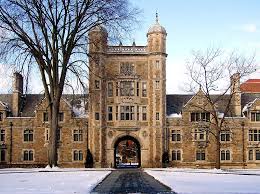





Ann Arbor is a city in the US state of Michigan and the county seat of Washtenaw County. The 2010 census places the population at 113,934, making it the sixth largest city in Michigan.[4] The Ann Arbor Metropolitan Statistical Area (MSA) includes all of Washtenaw County, which had a population of 344,791 as of 2010. The city is also part of the larger Detroit – Ann Arbor – Flint, MI CSA.
Ann Arbor was founded in 1824, with one theory stating that it is named after the spouses of the city's founders and for the stands of trees in the area.[5] The University of Michigan moved from Detroit to Ann Arbor in 1837, and the city showed steady growth throughout the 19th and 20th centuries, except during the Depression of 1873. During the 1960s and 1970s, the city gained a reputation as a center for liberal politics. Ann Arbor became a focal-point for left-wing activism and served as a hub for the civil-rights movement and anti-Vietnam War movement, as well as the student movement.
Ann Arbor is home to the University of Michigan, a world renowned institution of higher education. The university shapes Ann Arbor's economy significantly as it employs about 30,000 workers, including about 12,000 in the medical center. The city's economy is also centered on high technology, with several companies drawn to the area by the university's research and development money, and by its graduates.[6] In 2008, Money magazine ranked Ann Arbor, 27th out of the top 100 best places to live in America.[7] And in the year 2010, Forbes listed Ann Arbor as one of the most liveable cities in the United States of America.[8]
Ann Arbor was founded in 1824 by land speculators John Allen and Elisha Rumsey. On 25 May 1824, the town plat was registered with Wayne County as "Annsarbour"; this represents the earliest known use of the town's name.[9] There are various accounts concerning the origin of the settlement's name; one states that Allen and Rumsey decided to name it for their wives, both named Ann, and for the stands of burr oak in the 640 acres (260 ha) of land they purchased for $800 from the federal government at $1.25 per acre.[5] The local Ojibwa named the settlement kaw-goosh-kaw-nick, after the sound of Allen's sawmill.[10]
Ann Arbor became the seat of Washtenaw County in 1827,[11] and was incorporated as a village in 1833.[12] The Ann Arbor Land Company, a group of speculators, set aside 40 acres (16 ha) of undeveloped land and offered it to the state of Michigan as the site of the state capital, but lost the bid to Lansing. In 1837, the property was accepted instead as the site of the University of Michigan, which moved from Detroit.[13]
Since the university's establishment in the city in 1837, the histories of the University of Michigan and Ann Arbor have been closely linked.[14] The town became a regional transportation hub in 1839 with the arrival of the Michigan Central Railroad, and a north—south railway connecting Ann Arbor to Toledo and other markets to the south was established in 1878.[15] Throughout 1840s and the 1850s settlers continued to come to Ann Arbor. While the earlier settlers were primarily of British ancestry, the newer settlers also consisted of Germans, Irish,[16] and African-Americans.[17] In 1851, Ann Arbor was chartered as a city,[18] though the city showed a drop in population during the Depression of 1873.[15] It was not until the early 1880s that Ann Arbor again saw robust growth,[19] with new immigrants coming from Greece, Italy, Russia, and Poland. Ann Arbor saw increased growth in manufacturing, particularly in milling.[20] Ann Arbor's Jewish community also grew after the turn of the 20th century, and its first and oldest synagogue, Beth Israel Congregation, was established in 1916.[21]
Ann Arbor Job Listings
Ann Arbor Job Listings
Ann Arbor Job Listings
Ann Arbor Job Listings
Ann Arbor Job Listings
Ann Arbor Job Listings
Ann Arbor Job Listings
Ann Arbor Job Listings
Ann Arbor Job Listings
Ann Arbor Job Listings
Ann Arbor Job Listings
Ann Arbor Job Listings
Ann Arbor Job Listings
Ann Arbor Job Listings
Ann Arbor Job Listings
Ann Arbor Job Listings
Ann Arbor Job Listings
Ann Arbor Job Listings
Ann Arbor Job Listings
Ann Arbor Job Listings

No comments:
Post a Comment